
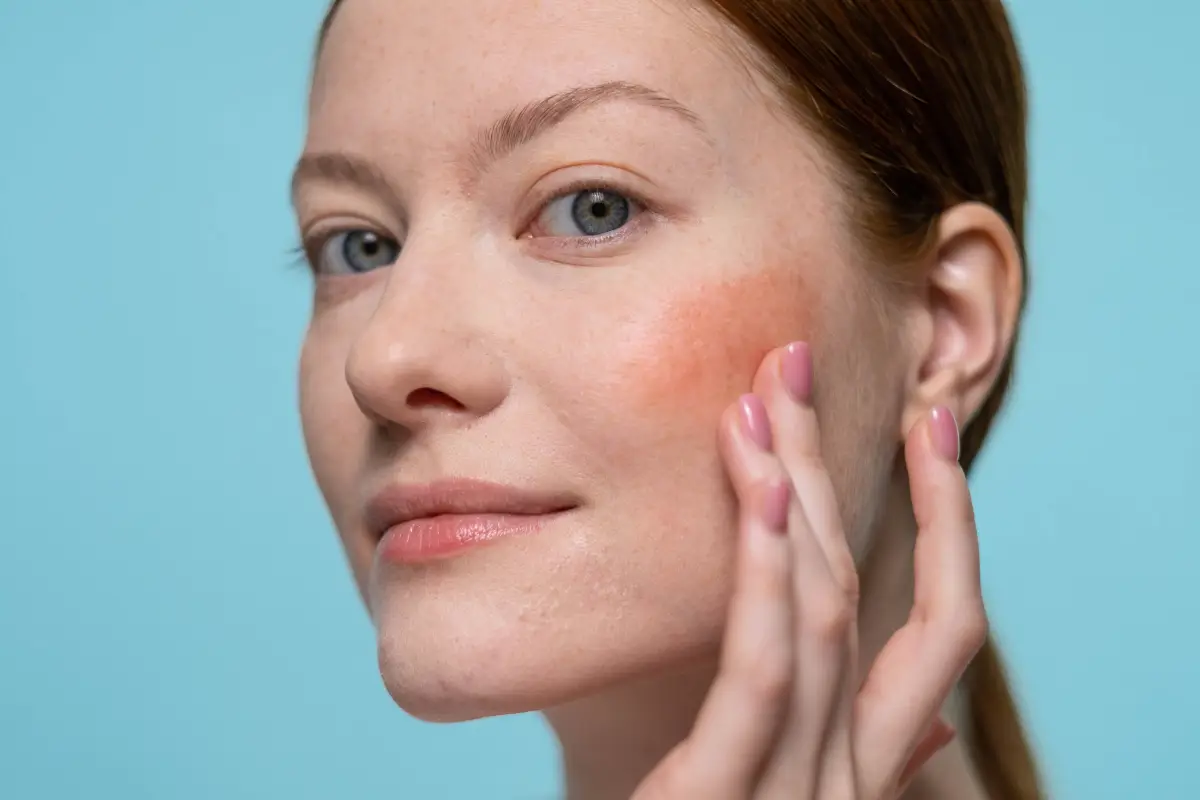
Last updated on June 17, 2026 by Giorgia Guazarotti
There’s a lot of noise right now about how Korean skin care can cure rosacea, and honestly half of it is proper science and the other half is just pretty packaging and vibes adorned with a Korean word that no one can pronounce properly. And look, I get the appeal, when your skin is flaring and someone tells you that a $12 essence with snail slime will fix everything, you want to believe them, because hope feels good and managing rosacea day to day is really exhausting. The thing is, not every ingredient that gets totally hyped to high heaven actually has the science to back it up, and some of the most modern ones may honestly do the opposite of what they promise on the label. So that’s what this article explores: which Korean skin care ingredients have actual clinical studies proving they help rosacea, which ones are based on good marketing and a satisfying jar texture, and which ones are sold as benign alternatives while quietly working against you.
What is Rosacea?
Rosacea is not just “sensitive skin that turns red easily”, even though it is often explained that way. this is a chronic inflammatory conditions Where your skin barrier (the outer layer that keeps moisture in and irritants out) is compromised before you even apply anything. Think of your skin barrier like the mortar between the bricks in a wall. When it’s healthy, it holds everything together tightly and nothing happens that shouldn’t. When it gets damaged, which is usually the case in rosacea, things tend to slip more easily: Irritants get in, water goes out, and your immune system overreacts to something that’s normally ignored.
This is why people with rosacea often react to products that would be perfectly fine on someone else’s skin type. It’s not that you’re “too sensitive” or “difficult”, it’s that the protective layer is already under stress, and anything you add to it either helps rebuild that wall or makes it worse. This is exactly why Korean skin care’s obsession with barrier repair makes a lot of sense for rosacea, at least in theory, as much of the philosophy is built around hydration, gentle formulas, and not overloading the skin with active ingredients all at once.. But theory and evidence are not the same thing, so let’s go component by component.
Connected: Rosacea Treatment: 8 Ways to Reduce Redness
centella asiatica
Centella Asiatica, sometimes called Cica, is what I actually named myself after. This is not just a popular K-beauty term, there is a proper randomized controlled trial behind it, specifically in rosacea patients. A The 2024 study was published in the Journal of Cosmetic DermatologyRun in two dermatology centers in Shanghai, 64 women with mild to moderate rosacea were taken and one group was asked to use a Centella-based repairing mask along with their regular antibiotic treatment, while the control group used just the antibiotic and a moisturizer. After six weeks, the Centella group showed significantly better improvements across the board (less flushing, less dryness, lower disease severity scores) and zero adverse reactions were recorded. Additionally, Centella has been tested for allergy potential and consistently appears to pose a low risk, even on people who are already prone to irritation. Purito Wonder Relief Centella Serum Unscented ($23.00) Contains a high concentration of Centella Asiatica + plenty of other soothing ingredients to soothe red and irritated skin.
niacinamide
Niacinamide is another that really deserves the hype, and this surprises some people because niacinamide is talked about so much in just about everything (acne, dark spots, pores) that it almost seems too good to be true. But there are many clinical trials not only on sensitive skin in general, but also on rosacea patients specifically. One split face test Niacinamide was mixed with hyaluronic acid and a probiotic ingredient, which means they tested one side of someone’s face against the other, which is a really clever way to control for all the random variation between different people’s skin. The niacinamide side showed significantly less redness after just two weeks, and improvements continued to increase until the one-month mark.
The mechanism also makes sense: Niacinamide helps your skin produce more ceramides, which are basically the fatty “glue” that holds your barrier together, so it directly addresses the root problem rather than just temporarily hiding redness. Cox The Niacinamide 15 Serum ($25.00) is a no-frills serum with a high concentration of Vitamin C to soothe, fade dark spots, and hydrate the skin.
Green tea extract, specifically the compound EGCG, contains Actual published research in JAAD It showed a reduction in inflammatory lesions in papulopustular rosacea compared to placebo cream, with 70% of treated patients reaching clear or minimal results. A separate biopsy studies Found that it actually reduces blood vessel growth factors (VEGF and HIF-1α, if you want the technical name) which causes the visible broken capillaries known as rosacea. This is a real mechanism, not some vague “antioxidant” claim. Innisfree Green Tea Seed Hyaluronic Cream ($26.73) has plenty of green tea, plus it’s very moisturizing.
snail mucin
A 2024 review in the Journal of Cosmetic Dermatology Specifically looked at snail mucin research and clearly stated that claims about it treating rosacea are not supported by the currently existing literature. This does not mean that it is harmful or does not work. There is good laboratory evidence that the proteins it contains aid wound healing and have some anti-inflammatory properties at the cellular level. But “showing promise in a petri dish” and “proving to be helpful for your rosacea” are two very different claims, and brands intentionally blur that line as they sell products. Cox Advanced Snail 92 All in One Cream ($21.90) is a simple moisturizing cream that leaves your skin soft and supple. It might not do much for rosacea, but if your skin needs the extra moisture, it will appreciate it.
A type of plant
Actual contact allergy studies into propolis show that rosacea patients have a particularly high risk of reacting to it compared to the general population. A German multicenter observational study of 361 rosacea patients. A significantly higher risk of contact allergy to propolis was found in that group, and a separate spanish retrospective analysis Same pattern confirmed. The theory is that the same compromised barrier that causes rosacea makes it easier for the skin to develop sensitivity to things it regularly comes in contact with, and propolis happens to be one of the more common culprits.
Royal jelly, being another bee-derived ingredient, falls into a similar category of known sensitizers, even though it doesn’t yet have the same amount of rosacea-specific research behind it. If your skin is already reactive, I would really treat anything derived from bees with caution rather than assuming “natural” automatically means “safe”, as these two terms are not synonymous, no matter how often they are used together on the packaging.
Korean Skin Care for Rosacea: What Not to Do and What Really Helps
- Fragrances and essential oils, There are well-documented triggers for rosacea flares, including tea tree, and unfortunately a lot of Korean skin care, especially older or more traditional formulations, rely on botanical scents for that “natural” feel. Always check the ingredients list, not just the marketing on the front of the bottle.
- sunscreen matters Excessively too, as UV exposure is one of the most frequent rosacea triggers. You may often hear that mineral sunscreens are “better” than chemical sunscreens for rosacea, and while mineral formulas are already gentle on irritated skin, they also usually come with a white cast and a greasy texture.
- And finally, the famous Korean ten-step routine isn’t really necessary, And if your skin barrier is already struggling it may be actively working against you. Fewer products, used consistently, with active ingredients that actually have evidence behind them will take you further than ten steps of trial and error.
So, should you really try Korean skincare for rosacea?
The honest answer is: some of it, yes, and some of it should stay on the shelf. Centella, niacinamide, and green tea extract aren’t just trendy K-beauty buzzwords. They have real clinical trials behind them, run on real rosacea patients, with measurable improvements in redness and barrier function. Snail mucin is highly promoted, while propolis is best avoided. It all comes down to reading past the K-beauty hype and actually checking out what’s in the bottle rather than trusting a product just because it’s wrapped in minimal packaging and a soothing pastel color palette. Your skin doesn’t care how a product is marketed. It only cares about what’s actually in it and whether it will bother him or calm him down.
