
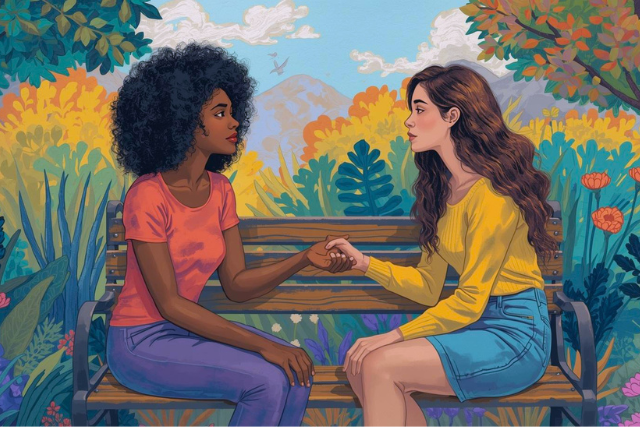
“We don’t build trust by offering help. We build trust by asking for help.” ~Simon Sinek
I have always been a strong sister, partner and friend.
I didn’t make a conscious decision to become stronger one day and stuck to it. Being the first daughter, she became like this from a very young age. I was used to carrying more burden than my brothers and sisters. Being strong and responsible was rewarded by my parents, and that’s what keeps people close.
I’m the friend you call when you can’t think straight. I am the friend who celebrates your victories. Medical friend. Inspiration friend. The one who will sit with you for six hours, put everything she has into that conversation, and then go home and need three days of silence to replenish herself. And then I’ll send you a text to check in. Because that’s what I do.
I never sat down and thought about whether I was a good friend or what I wanted from my friendship.
The question no one was asking…
Simon Sinek has an exercise he calls friends exercise. He suggests that you call your closest friends and ask them a simple question: Why are you my friend?
Simon says the first responses you’ll get may be superficial things like you’re loyal, fun, and a good listener. But you’re looking for more in-depth answers. Sinek explains that what you’re really hearing comes after your friend stops describing you and starts describing how they are. feel When they are around you. That change is where your real impact lies.
So I called. I texted. My four closest friends.
Here’s what came back: great friend, always willing to listen, heart of gold, someone to bounce ideas off of, smart, funny, courageous, authentic, inspirational, motivational. I like positive things my friends say to me. I felt proud after hearing this.
And then, almost immediately, I felt something else.
Why are none of my friendships emotional?
I started thinking about how vulnerable I am with my close friends. Do I feel comfortable asking for help? How vulnerable can my friends be with me? Do they feel comfortable asking me for help? My friends’ reactions were great, but I wondered what else they thought of me. So I pondered the question of how my friends also came for me.
That was information I was not prepared for.
hidden pattern behind strength
I know so much about myself now that I didn’t have the words for then.
Other than anger and frustration, I don’t bring my emotions into my friendships. Not necessary. When we come across something hard, we smooth it out quickly. We go straight into problem-solving mode. we say Its going to be alright Before the other person can complete their sentence.
My friendships looked a lot like my romantic relationships. We were all, in our own ways, emotionally unavailable. Or at least I was. And I had created a circle that matched that frequency, without even realizing it.
After recently reading a book on friendship, I realized that I have been delaying spiritual intimacy instead of creating it. I was that person who always showed up, always responded, always held space, but I wasn’t creating closeness. I created a role. And a role is not the same as a relationship.
My friendships began to revolve around who I am and what I offer. I wasn’t insecure, showing a frustrated, angry, or sad side to some of my friends, even though we had years of friendship between us. I was constantly showing up and playing the part. That difference came to me slowly, then all at once.
where it really came from
I was that girl who didn’t have any friends growing up. Not the way other girls looked. Not the sleepovers, the trips to the mall, and the person who was always someone’s person. I spent a lot of time alone during my youth. So I learned early on to be self-reliant when it came to connections. Don’t need too much. Being valuable enough to keep around without requiring maintenance.
This is why I believe emotional connection never came naturally to me. It felt foreign. Like a language I understood intellectually but never actually spoke out loud.
By the time I became an adult, I had become someone people depended on. Someone who gave freely and received carefully. And I told myself that I am the one who doesn’t have to be emotionally open to everyone to have a good friendship.
Somewhere along the way I also made a conscious choice that I didn’t want a single best friend. The one person who was my everything felt too much weight going in both directions. I didn’t want to take it. I didn’t want anyone to take it for me.
What I didn’t see was how that decision was quietly shaping everything else. The help I never asked for. The vulnerability I kept just out of reach. The version of me that only came once I cleaned myself up a bit.
What did the audit reveal?
When I thought about what really creates closeness in friendship, three things stood out to me: support, similarity, and trust. To support each other when life gets crazy. Symmetry is the feeling that the relationship goes both ways – not just one person giving and the other receiving. And trust is the calm understanding that certain interactions go on safely between you.
I had the support piece. I had a piece of privacy. Symmetry was what I had been quietly avoiding. Because true symmetry means you need things too. You have to make yourself the person who takes calls at 2 am instead of just answering calls. You have to bring your real, unadulterated life to the friendship – not just a preconceived version of yourself.
My two closest friends are local. Two more live far away. The response all around was the same: I am inspiring. I am motivating. I am safe to come.
What wasn’t in any of them? A moment when I felt I needed something.
That was also data.
talk about asking
Simon Sinek said something that stopped my chills.
“We don’t build trust by offering help. We build trust by asking for help.”
I had it completely backward. I thought that having a strong friend – who never needed anything – was what made me trustworthy. What made me worth keeping? What made friendship real?
But what Sinek is pointing to is something deeper. When you never ask for help, you deny the people who love you the honor of coming before you. You make the relationship one-sided without any reason. And one-directional relationships, no matter how loving, ultimately create distance.
Asking for help is not a weakness. This is not a burden. In fact, it’s one of the most intimate things you can give someone – the trust that they can confide in you, too.
what changed for me
I started small.
instead of “How are you?” I started asking my friends, “How are you feeling emotionally??” Specific, intentional, a little awkward at first. Our friendship was always based on the bright side of things. Naming the emotional layer out loud felt awkward to all of us.
But I kept doing it. And I started letting myself say when things weren’t good for me. When I felt sad. When I was struggling. Not as a demonstration, not as an overshare – but as an act of leading by example. The more vulnerable I was willing to be, the safer it became for them to be vulnerable too.
it worked. Slowly, in small ways, real things change.
My friend of over twenty years recently told me, quietly, in the middle of a casual conversation, that I am too hard on myself. I accepted it. I said I needed to show myself more kindness.
It was a small moment. It wasn’t dramatic. But I sat with it for several days.
Because it meant she was paying attention. This meant that she was saying it at the end rather than ending the conversation. It meant that we were, after so much time, finally choosing each other instead of the easy, spontaneous version of friendship.
Now its your turn…
If you are the strong friend, the healing friend that everyone depends on, this is for you.
Try the Simon Sinek exercises. Call the people who matter most and ask them why they are your friends. Then consider what the feedback tells you and what it doesn’t.
Notice if your strength has quietly become a wall. Notice whether people around you are aware of the parts of you that are still being put together. Notice if you ever let someone take something for you.
Asking for help is not the end of being strong. This may actually be the place where your strength finally finds rest.
And the friendships that can sustain it? Only they are worthy of construction.

About Siedah Johnson
Siedah Johnson is a writer and author I am love: learn to love yourself and harness your power. through its publication, Writer’s AlchemyShe writes about self-love, healing generational patterns, and the relationships we create with ourselves and others.
